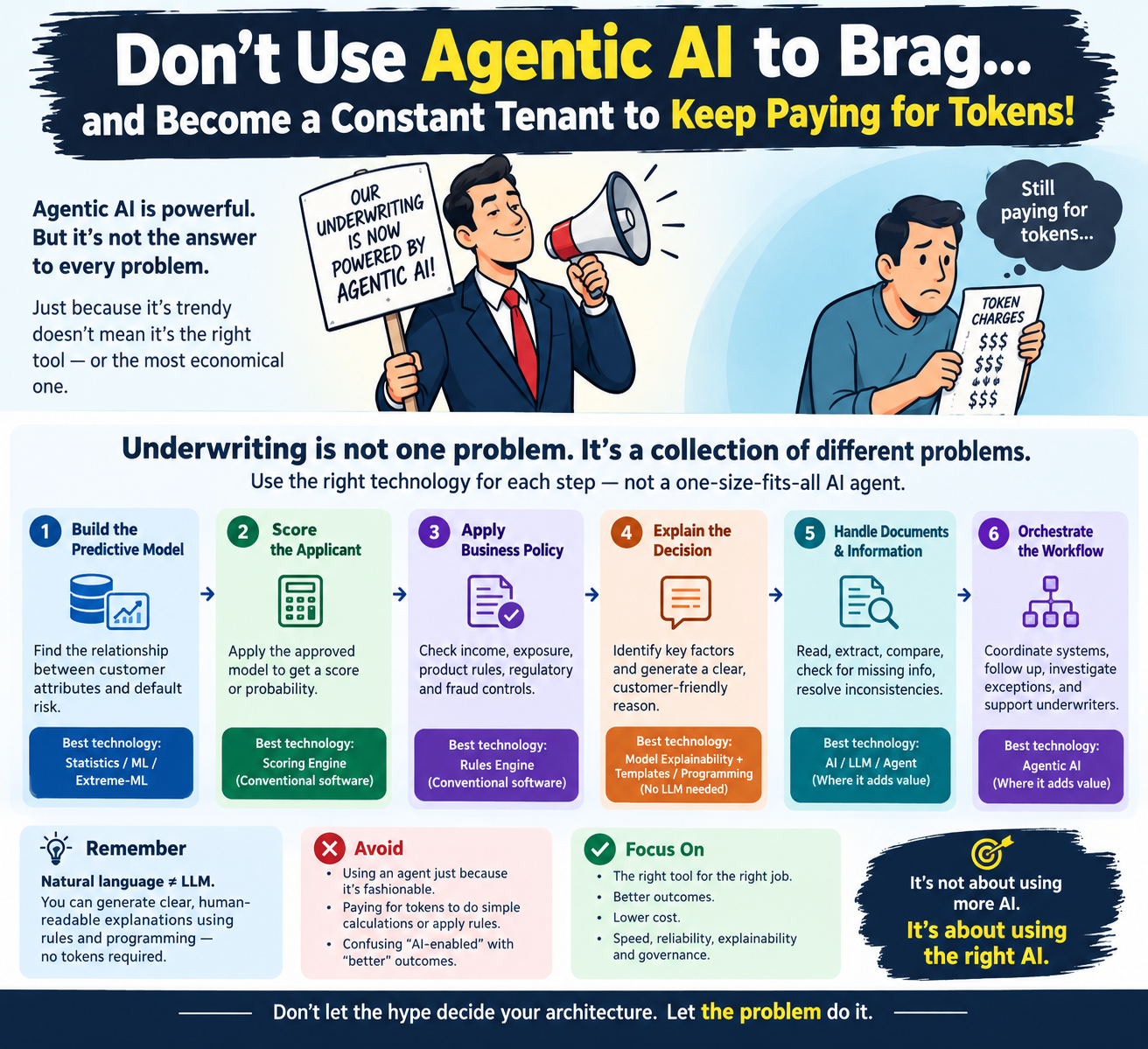
Use AI Where It Adds Value — Not Where It Just Sounds Good
There is enormous excitement around Agentic AI today.
Where Should We Use Agentic AI?
Everywhere we look, businesses are being told that their processes should become “agentic.” Underwriting, credit decisioning, customer service, analytics, operations—even simple calculations are being presented as opportunities for AI agents.
But perhaps we should pause and ask a very simple question:
Do we actually need an AI agent for this job?
AI is a powerful technology. But using more AI does not automatically mean using better technology.
Sometimes the best solution is an AI agent.
Sometimes it is Machine Learning.
Sometimes it is a rules engine.
And sometimes it is simply a few lines of conventional programming.
The objective should not be to say “We use Agentic AI.”
The objective should be to solve the business problem better.
Let’s take credit underwriting as an example
Underwriting is often presented as an excellent use case for Agentic AI.
But underwriting is not one single problem. It is a collection of very different problems.
And each problem may require a different technology.
Step 1: Developing the predictive model
Suppose a bank wants to answer:
“What is the probability that this applicant will default?”
This requires analysing historical data and discovering relationships between variables such as credit history, utilization, repayment behaviour, income and other relevant charactkeristics.
The objective is to develop a statistically sound predictive model.
This is fundamentally a Statistics / Machine Learning / Data Science problem.
You need to:
- analyse data
- identify useful variables
- transform variables where appropriate
- develop candidate models
- compare models
- validate performance
- test stability
- assess explainability
- select the appropriate model
- establish appropriate cut-offs
Why would we use an LLM agent for this simply because it is fashionable?
A purpose-built analytics and ML platform such as Extreme-ML is designed specifically for this kind of work.
The technology should be selected based on the problem—not based on what is currently fashionable.
Step 2: Scoring the applicant
Now assume that the model has already been developed, validated and approved.
A new applicant arrives.
The question is now:
“What score does this applicant get from the approved model?”
This is no longer a model-development problem.
It is a scoring problem.
The model already exists.
For a logistic regression model, the score can be calculated mathematically.
For a decision tree, the applicant simply travels through the appropriate branches until reaching the relevant leaf.
For other models, the corresponding mathematical function is executed.
So why introduce an AI agent?
The computer does not need to “think” about the score.
It needs to calculate the score correctly.
A conventional scoring engine can do this:
- faster
- cheaper
- consistently
- deterministically
- at very large scale
- without consuming LLM tokens
This is an important principle:
Don’t use a probabilistic language model for a deterministic mathematical calculation unless there is a genuine reason to do so.
Step 3: Applying underwriting policy
Suppose the model produces a score.
The bank may then have policies such as:
- minimum score
- maximum exposure
- income criteria
- existing customer criteria
- product eligibility
- fraud controls
- regulatory requirements
- internal risk policies
These are primarily business rules.
For example:
If score > X and income > Y and exposure < Z → eligible.
This does not require an AI agent.
A conventional rules engine can execute these rules quickly, consistently and transparently.
Again:
Model Score + Business Rules → Decision
No agent is inherently required.
Step 4: Explaining why the decision was made
This is another area where Agentic AI is sometimes unnecessarily introduced.
Suppose the model identifies that an applicant’s score was negatively affected by:
- high credit utilization
- recent delinquency
- short credit history
A conventional program can identify the largest negative contributors and map them to predefined reason codes.
It can then generate a customer-friendly explanation such as:
“Your application was declined primarily because of high credit utilization and recent delinquency.”
This is perfectly understandable natural language.
But natural language does not automatically mean LLM.
Reason-code systems and programmed explanations have been used in credit decisioning for decades.
A deterministic program can take:
Model contribution → Reason code → Customer-friendly explanation
without using an LLM, an agent or a single token.
And there is a significant advantage:
The explanation is controlled, reproducible and directly linked to the approved decisioning model.
An LLM could be useful for a genuinely conversational interface around the decision, but an LLM is not required merely to explain a model-generated decision.
So where DOES Agentic AI add value?
This is where we should be fair to Agentic AI.
There are many parts of the underwriting process where an AI agent can genuinely add value.
For example:
An agent could:
- collect information from multiple systems
- retrieve documents
- check whether documents are missing
- read unstructured documents
- extract information from bank statements
- compare information across documents
- identify inconsistencies
- retrieve relevant internal policies
- prepare an underwriting case summary
- communicate with an underwriter
- investigate exceptions
- coordinate actions across multiple systems
These are different types of problems.
They involve understanding information, interacting with systems, retrieving knowledge, making contextual decisions and orchestrating multiple steps.
That is where Agentic AI can be extremely useful.
The important distinction
Consider these two tasks:
Task A
“Calculate the credit score using this approved model.”
That’s a deterministic mathematical problem.
Task B
“Collect the applicant’s documents, examine the information, identify inconsistencies, check the relevant policy documents, ask for missing information and prepare a case for the underwriter.”
That’s a workflow and knowledge-orchestration problem.
Task A doesn’t need an agent.
Task B potentially does.
The mistake is treating both as “AI problems” and automatically putting an AI agent in the middle.
A simple framework
Before introducing Agentic AI, ask what type of problem you actually have.
| Problem | Usually appropriate technology |
|---|---|
| Read and understand unstructured documents | AI / LLM |
| Extract information from documents | AI / NLP / LLM |
| Search large amounts of unstructured information | Search / RAG / LLM |
| Coordinate multiple systems and steps | Agentic AI |
| Investigate exceptions | Agentic AI can add value |
| Summarize information for a human | LLM |
| Discover patterns in historical data | Statistics / Machine Learning |
| Develop predictive models | ML / Data Science |
| Apply an approved predictive model | Scoring engine |
| Apply predefined business policy | Rules engine |
| Calculate reason codes | Conventional programming / model explainability |
| Generate predefined customer explanations | Templates / conventional programming |
| Perform mathematical calculations | Conventional software |
The cost question is also important
There is another issue that is sometimes overlooked.
Many LLM-based solutions operate on a token-based cost model.
If an LLM is used to perform a task hundreds of thousands or millions of times, the organization may continuously pay for those tokens.
That may be perfectly reasonable if the LLM is doing something valuable that conventional software cannot easily do.
But if the task is simply:
Apply a mathematical formula → produce a number
or:
Check a predefined rule → produce a decision
then we should ask:
Why are we paying an AI company every time a computer performs a calculation that conventional software can perform directly?
The answer may sometimes be justified.
But it should be a conscious business decision—not an automatic consequence of an “AI-first” strategy.
Don’t confuse “AI-enabled” with “better”
There is a growing tendency to make a solution sound more sophisticated by adding words such as:
AI-powered
GenAI-powered
Agentic AI
Autonomous AI
But technology terminology should never replace engineering judgement.
A solution isn’t better because it contains more AI.
It is better if it delivers:
Better outcomes + lower cost + appropriate speed + reliability + explainability + governance
The ideal architecture may use many technologies
A mature underwriting platform could actually look like this:
Agentic AI
Collect information → Read documents → Retrieve policies → Investigate exceptions → Orchestrate workflow
↓
Machine Learning / Data Science
Develop → Validate → Monitor predictive models
↓
Scoring Engine
Apply the approved model
↓
Rules Engine
Apply business and credit policies
↓
Explainability / Reason-Code Engine
Identify the factors driving the decision
↓
Decision
Approve / Decline / Refer
Notice something important:
There is no requirement for Agentic AI to sit in every box.
Each component performs the job for which it is best suited.
The principle I would like the industry to adopt
We should stop asking:
“Where can we use Agentic AI?”
and start asking:
“Where does Agentic AI create incremental value compared with the simpler alternatives?”
If an agent saves significant human effort, handles complexity, connects systems and improves outcomes—use it.
If Machine Learning is the right tool—use ML.
If a rules engine is sufficient—use a rules engine.
If a mathematical calculation is all that is required—use conventional software.
And if a process genuinely benefits from an LLM—use the LLM.
There is nothing wrong with using less AI when less AI is the better engineering decision.
Don’t use Agentic AI just to impress at a conference
Perhaps this is the most important message.
We should not build an Agentic AI solution simply so that a presentation can say:
“Our underwriting platform is now powered by Agentic AI.”
The customer doesn’t ultimately care how many AI agents are running behind the scenes.
The customer cares about:
Is the decision accurate?
Is it fast?
Is it explainable?
Is it compliant?
Is it reliable?
Is it economical?
Technology should serve those objectives.
Not the other way around.
The bottom line
Agentic AI is a powerful tool.
But it is a tool—not a religion.
Use it where it adds genuine value.
Don’t use it where conventional programming, rules engines, statistics or Machine Learning already solve the problem better.
And most importantly:
Don’t put an AI agent into a process just so you can say you are using AI.
Use the technology that is best suited to the job.