Are Organisations Using Generative AI Where It Isn’t Needed?
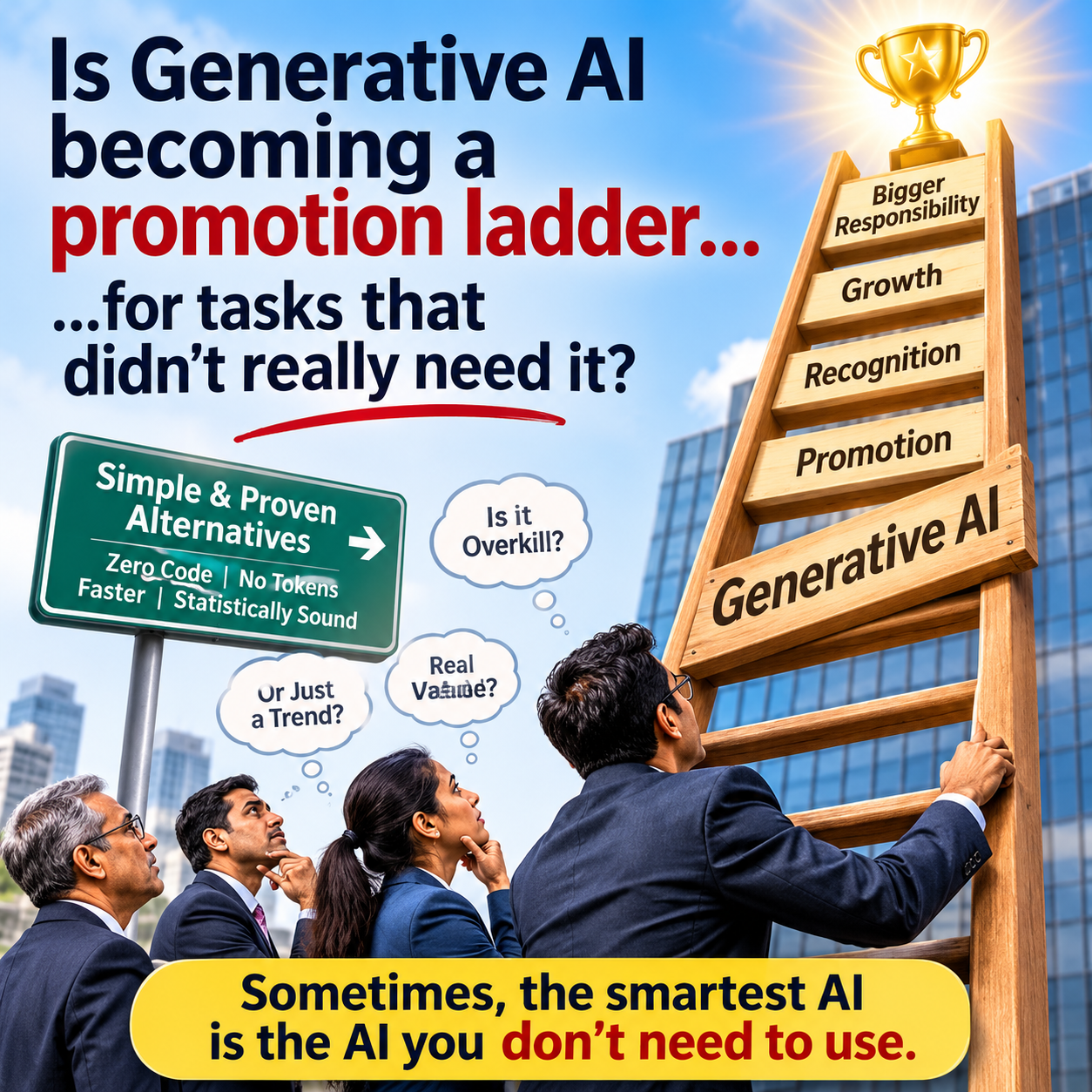
Generative AI has become more than a technology opportunity. It has become a business priority, a career opportunity and, for some professionals, a ladder to visibility, recognition and bigger responsibilities. But are organisations sometimes using Generative AI to solve problems that never really needed it?
The Generative AI Gold Rush
Something interesting is happening in organisations across the world.
Generative AI has moved from being an emerging technology to becoming a boardroom priority. Almost every organisation wants an AI strategy, every technology team wants an AI initiative, and every business function is exploring opportunities to introduce Generative AI into its operations.
For some senior professionals, it has also become an opportunity for greater visibility, recognition, promotion and leadership responsibilities.
And who can blame them?
Everyone wants to be part of the AI revolution. Leaders are under pressure to demonstrate innovation, technology teams want to stay relevant, and organisations don’t want to be left behind.
However, there is an important question we should probably be asking:
Are we sometimes overcomplicating relatively simple business problems just because Generative AI is currently fashionable?
Not Every Business Problem Needs Generative AI
Consider two relatively common activities in almost every organisation: data exploration and dashboarding.
Organisations spend considerable time and resources understanding business performance, exploring datasets, identifying patterns, detecting anomalies and building dashboards.
But do these activities necessarily require Generative AI?
Let’s look at some examples.
- Dashboarding: Creating dashboards, visualisations and routine reports is fundamentally an automation and data-processing activity. It doesn’t inherently require an LLM.
- Data exploration: Exploring distributions, identifying outliers, examining relationships between variables and generating descriptive statistics are established analytical tasks.
- Statistical analysis: Regression, hypothesis testing, correlation analysis and statistical inference don’t require probabilistic text generation.
- Routine business insights: Identifying trends, segmenting customers, comparing performance and highlighting anomalies can often be accomplished using established analytical techniques.
Zero-code data exploration and dashboarding are already possible through specialised analytical platforms.
Why introduce an LLM into every step when the underlying task can be performed without one?
The Technology Mismatch: LLMs vs Statistical Analytics
It is important to understand that Artificial Intelligence did not begin with Generative AI.
Machine learning, statistical modelling, forecasting, clustering, optimisation and predictive analytics have been solving business problems for decades.
Generative AI, particularly Large Language Models (LLMs), has introduced remarkable capabilities in understanding and generating natural language, summarising information, assisting with coding and enabling conversational interfaces.
These are significant advances.
However, an LLM is not automatically the best analytical engine for every business problem.
For example, if an organisation wants to:
- Identify customers likely to discontinue their relationship.
- Detect unusual patterns in transactions.
- Predict future collections or revenue.
- Identify customer segments.
- Understand the drivers of business performance.
- Explore relationships between hundreds of variables.
Established statistical and machine learning techniques can often perform these activities more efficiently and with greater analytical control.
There is no inherent advantage in introducing probabilistic text generation into a task that requires statistical computation.
The objective should be to select the right analytical methodology, not to force every analytical task through an LLM.
The Hidden Cost of Generative AI Adoption
There is another dimension that deserves more attention: economics.
Every time an organisation uses a hosted LLM, there may be token consumption, API charges and additional infrastructure costs.
When these interactions are repeated across thousands of users and millions of analytical operations, the cost can become significant.
But token cost is only one part of the equation.
Organisations also need to consider:
- Latency: Additional LLM calls can increase response time when deterministic computation would be sufficient.
- Reliability: Probabilistic outputs may introduce variability into tasks that require reproducible results.
- Data governance: Sending enterprise data to external AI services may introduce additional security, privacy and compliance considerations.
- Vendor dependency: Continuous reliance on external AI providers can create long-term cost and technology dependencies.
- Operational complexity: Additional services, integrations and infrastructure need to be managed and maintained.
Does every organisation really need to become a perpetual tenant of Generative AI providers for activities that could be accomplished without consuming a single token?
This is not an argument against using LLMs. It is an argument for using them selectively.
The Rise of Zero-Code, Zero-Token Analytics
An interesting alternative is emerging through specialised zero-code analytical platforms.
These platforms allow business users, analysts and data scientists to explore datasets, generate visualisations, perform statistical analysis and build predictive models without writing code or relying on text prompts.
The benefits can be substantial:
- Faster data exploration and analysis.
- No dependence on LLM tokens for analytical execution.
- Reproducible statistical and machine learning workflows.
- Reduced technical barriers for business users.
- Greater control over enterprise data and deployment.
- Less dependency on external Generative AI services.
Of course, the quality of the results still depends on the underlying algorithms, data quality and implementation.
But the important point is that zero-code analytics does not have to mean LLM-powered analytics.
There is room for specialised platforms that focus on doing analytical work directly, rather than generating instructions for another system to execute.
Perhaps the Next Big Leadership Opportunity Is Knowing Where NOT to Use AI
Technology leaders are often recognised for introducing new technologies, driving transformation and demonstrating innovation.
But perhaps we need to redefine what technological leadership means in the Generative AI era.
It shouldn’t simply be about identifying more opportunities to introduce AI.
It should also be about questioning whether AI is necessary in the first place.
When does an organisation genuinely need an LLM? When is conventional automation sufficient? When should statistical modelling be preferred? And when does Generative AI actually deliver incremental business value?
These are equally important questions.
A mature technology strategy should evaluate business outcomes, accuracy, speed, cost, reliability, security and long-term sustainability before selecting a technology.
The smartest decision may sometimes be to avoid introducing another AI dependency.
The Bottom Line
Generative AI is undoubtedly transformative. It will change how organisations operate, how people work and how businesses create value.
But technological progress does not mean replacing every existing process with Generative AI.
There will always be tasks where LLMs are the right choice. There will also be many tasks where conventional automation, statistical methods and specialised analytical platforms remain faster, more economical and more appropriate.
The real opportunity is not to use Generative AI everywhere.
It is to understand where it genuinely adds value.
Sometimes, the smartest AI is the AI you don’t need to use.
Frequently Asked Questions
1. Does data analytics require Generative AI?
No. Many data analytics activities, including data exploration, statistical analysis, visualisation, forecasting and predictive modelling, can be performed using conventional statistical and machine learning techniques without Generative AI.
2. Can dashboards be created without Generative AI?
Yes. Dashboards can be created using zero-code analytics platforms, business intelligence tools and conventional automation. An LLM is not a technical requirement for dashboard creation.
3. What is zero-code data analytics?
Zero-code data analytics allows users to explore data, perform statistical analysis, create visualisations and build analytical models through a graphical interface without writing programming code.
4. Does using Generative AI increase business costs?
It can. Hosted LLM usage may involve token-based API charges, infrastructure expenses and integration costs. The overall cost depends on the model, usage volume, deployment architecture and application. Organisations should evaluate whether an LLM is necessary for each use case.
5. What is the difference between Generative AI and traditional machine learning?
Generative AI creates new content such as text, images and code based on learned patterns. Traditional machine learning typically focuses on tasks such as classification, regression, forecasting, clustering and prediction. Both have important but different applications.
6. When should organisations use Generative AI?
Generative AI is particularly useful for natural language understanding, content generation, summarisation, conversational interfaces, document processing and tasks involving unstructured information. It should be adopted when its capabilities deliver measurable value beyond simpler alternatives.
7. Can zero-code analytics tools work without LLM tokens?
Yes. Analytical platforms that execute statistical and machine learning algorithms directly can perform many analytical tasks without sending prompts to an LLM or consuming LLM tokens.
Explore Extreme-ML: Zero-Code, Zero Prompt Unified Data Science and Analytics Platform
If you are looking for an alternative to prompt-driven analytics, explore Extreme-ML – a zero-code, unified platform that brings together data exploration, ad hoc data visualisation, statistical analysis, machine learning, predictive modelling, text mining and several other analytical capabilities in one environment.
Designed for data scientists, analysts and business users, Extreme-ML enables users to perform complex analytical tasks without writing code or consuming Generative AI tokens for its analytical execution.
Want to see it in action? Watch the Extreme-ML demo video to explore how data exploration, visualisation and advanced analytics can be performed through a unified zero-code platform.
- Extreme-ML zero-code analytics platform → https://pro-datascience.com/extreme-ml/
- Watch the Extreme-ML product demonstration → https://youtu.be/KzqqrXvdaF8
#Generative AI, #AI Adoption, #Enterprise AI, #Data Analytics, #Zero-Code Analytics, #Statistical Modelling, #Digital Transformation, #AI Cost Optimisation