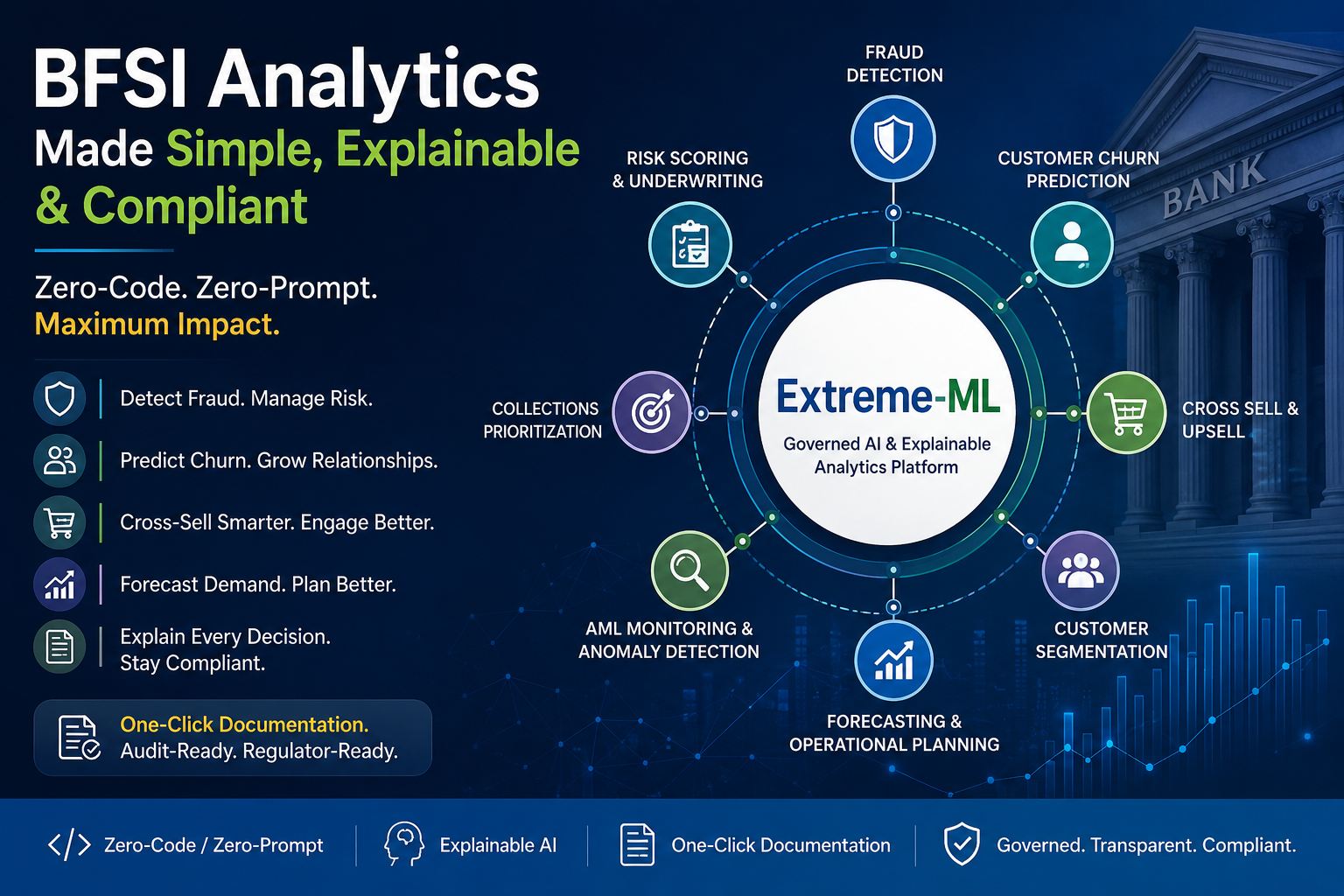
The Banking, Financial Services, and Insurance (BFSI) industry is under constant pressure to make faster decisions, reduce risk, improve customer experience, prevent fraud, and comply with increasingly stringent regulatory expectations.
At the same time, organizations are generating massive amounts of transactional, behavioral, operational, and customer data every day. The challenge is no longer the availability of data — it is the ability to convert data into explainable, actionable, and scalable intelligence.
Traditionally, solving these problems required:
- Highly skilled data science teams
- Significant coding effort
- Multiple disconnected tools
- Long development cycles
- Extensive documentation and compliance work
This is where Extreme-ML changes the equation.
Developed by ProData Science Consultancy Pvt Ltd, Extreme-ML is an AI-assisted, zero-code / zero-prompt analytics and machine learning platform designed to help organizations rapidly build explainable analytical solutions with minimal dependency on programming.
Rather than positioning analytics as an isolated data science exercise, Extreme-ML enables BFSI organizations to operationalize analytics across business, risk, operations, compliance, collections, marketing, and customer management functions.
The BFSI Analytics Problem Landscape
Most BFSI analytical use cases are fundamentally built on a limited set of machine learning and statistical patterns:
| BFSI Business Problem | Underlying Analytics Type |
| Fraud Detection | Classification / Anomaly Detection |
| Credit Risk Scoring | Classification |
| Customer Churn Prediction | Classification |
| Cross Sell / Upsell | Classification / Recommendation |
| Loan Default Prediction | Classification |
| Collections Prioritization | Classification / Forecasting |
| Demand & Transaction Forecasting | Time Series Forecasting |
| AML Monitoring | Anomaly Detection |
| Customer Segmentation | Clustering |
| Campaign Optimization | Clustering + Predictive Modelling |
| Branch / Operations Capacity Planning | Forecasting |
| Portfolio Monitoring | Statistical Analysis + Visualization |
The real challenge is not whether these techniques exist.
The real challenge is:
- how quickly they can be built,
- how consistently they can be governed,
- how transparently they can be explained,
- and how efficiently they can be operationalized.
Extreme-ML directly addresses these challenges.
1. Fraud Detection: Moving Beyond Rule-Based Systems
Fraud patterns evolve continuously. Static rule-based systems often generate:
- High false positives
- Delayed detection
- Limited adaptability
Extreme-ML enables BFSI organizations to rapidly build fraud detection frameworks using:
- Classification models
- Isolation Forest algorithms
- One-Class SVM
- Benford Law analysis
- Regression-based anomaly detection
- Cross-tab anomaly detection
- Time-series anomaly detection
Because the platform is zero-code, fraud analytics teams can:
- rapidly test multiple modelling approaches,
- compare model performance,
- validate results,
- and deploy explainable fraud scoring models faster.
The platform’s visual workflows also make fraud analysis easier for non-programming domain experts.
2. Credit Risk Scoring and Underwriting
Credit risk assessment is one of the most classical supervised machine learning problems in BFSI.
Extreme-ML supports:
- Logistic Regression
- Decision Trees
- Random Forest
- XGBoost
- AutoML Classification – enabling automated comparison of multiple classification algorithms to identify the most suitable modelling approach.
- Deep Neural Networks
These models can be used for:
- Probability of default prediction
- Loan eligibility scoring
- Delinquency prediction
- Risk-based pricing
- Portfolio quality monitoring
What makes Extreme-ML particularly valuable is that it simplifies the end-to-end process:
- Data preparation
- Variable transformations
- Variable binning
- Feature selection
- Model training
- Validation
- Monitoring
- Documentation
Typical work flow in Extreme-ML
Raw Data
↓
Automated Data Preparation
↓
EDA & Visualization
↓
Model Development
↓
Validation & Monitoring
↓
One-Click Documentation
This dramatically reduces dependency on multiple tools and fragmented workflows.
3. Customer Churn Prediction
In banking and insurance, customer attrition is expensive.
Customers often display early warning signs before leaving:
- Reduced transactions
- Lower engagement
- Product inactivity
- Complaint escalation
- Reduced digital interactions
Extreme-ML allows organizations to rapidly build churn prediction models using supervised learning techniques.
The platform’s ability to automatically:
- perform automated data treatment,
- perform transformations,
- create dummy variables,
- and compare algorithms
helps business teams identify high-risk customers quickly.
More importantly, because the workflows are explainable and visual, business stakeholders can better understand:
- why customers are likely to churn,
- which variables matter most,
- and which intervention strategies may work best.
4. Cross Sell and Upsell Intelligence
Cross sell and upsell analytics are fundamentally predictive classification problems.
Banks and insurance firms often struggle with:
- identifying the right product for the right customer,
- timing offers correctly,
- and avoiding irrelevant campaigns.
Extreme-ML supports:
- Recommendation systems
- Collaborative filtering
- Classification modelling
- Market basket analysis
- Association rule mining
This enables organizations to:
- predict product affinity,
- identify customer purchase patterns,
- discover hidden product relationships,
- and optimize campaign targeting.
Combined with cluster analysis, BFSI firms can design far more personalized marketing communication strategies.
5. Customer Segmentation and Cluster Analysis
One-size-fits-all communication rarely works in modern BFSI environments.
Extreme-ML’s clustering capabilities allow organizations to segment customers based on:
- behaviour,
- spending patterns,
- risk characteristics,
- digital engagement,
- transaction habits,
- or lifecycle stages.
Using clustering and visualization together, organizations can:
- identify premium customer groups,
- detect dormant customers,
- isolate high-risk segments,
- optimize product positioning,
- and personalize marketing communication.
This becomes especially powerful when integrated with dashboarding and geo-visualization capabilities.
6. Forecasting Transaction Volumes and Operational Planning
Forecasting is critical for:
- branch staffing,
- collections bandwidth planning,
- ATM cash management,
- call centre operations,
- claims processing,
- and treasury planning.
Extreme-ML includes:
- SARIMA
- LSTM
- Seasonality decomposition-based forecasting
- Time-series anomaly detection
- Forecasting workflows
This enables BFSI organizations to:
- project future transaction volumes,
- anticipate workload spikes,
- prepare operational bandwidth,
- and improve resource planning.
Forecasting is no longer limited to specialist statisticians — business users can visually interact with forecasting workflows through a guided interface.
7. Explainable Analytics for Regulatory Compliance
One of the biggest emerging challenges in BFSI analytics is regulatory explainability.
Regulators increasingly expect organizations to demonstrate:
- how models were built,
- which variables were used,
- how model performance was evaluated
- how model robustness was validated,
.
Traditional data science workflows often create documentation gaps because:
- code is fragmented,
- workflows are manual,
- and knowledge resides with individuals.
Why Explainability Matters in BFSI Analytics:
It helps in:
- model governance,
- RBI expectations,
- audit readiness,
- decision traceability,
- bias monitoring,
- compliance documentation,
- explainable customer decisions.
Extreme-ML addresses this through:
- elaborate workflow traceability,
- detailed logs,
- explainable modelling steps,
- one-click elaborate documentation,
- validation reporting,
- and transparent modelling pipelines.
This can significantly support:
- model governance,
- audit readiness,
- internal review,
- and compliance documentation.
For BFSI organizations dealing with governance frameworks, this becomes a major operational advantage.
8. Democratizing Advanced Analytics Across BFSI Teams
A major problem in analytics adoption is the gap between:
- business teams,
- domain experts,
- and technical data scientists.
Extreme-ML bridges this gap through:
- zero-code workflows,
- guided interfaces,
- AI-assisted recommendations,
- visual analysis,
- automated data preprocessing code generation
- and automated text summaries.
This enables:
- risk teams,
- collections teams,
- operations teams,
- marketing teams,
- and compliance functions
to actively participate in analytics initiatives without heavy coding dependency.
9. Faster Time-to-Value
Traditional machine learning projects often involve:
- long development cycles,
- repeated coding,
- multiple tools,
- and heavy coordination overhead.
Extreme-ML integrates:
- data preparation,
- EDA,
- modelling,
- visualization,
- forecasting,
- monitoring,
- and documentation
within a unified platform.
The result is:
- faster experimentation,
- shorter model development timelines,
- quicker business deployment,
- and improved analytics scalability.
10. Built for Real-World Enterprise Usage
Extreme-ML has been validated on 700+ real-world datasets across domains and supports:
- large-scale datasets,
- concurrent users,
- cloud or on-premise deployment,
- scalable infrastructure,
- and enterprise-grade analytical processing.
The platform also supports:
- CSV
- Excel
- SAS
- JSON
- Parquet
- Pickle
- Joblib
along with database integrations.
Final Thoughts
Most BFSI analytical challenges are not isolated problems.
They are recurring analytical patterns requiring:
- rapid experimentation,
- explainability,
- operational scalability,
- governance,
- and business accessibility.
As a Governed AI & Explainable Analytics Platform, Extreme-ML enables:
- governed analytics,
- explainable AI,
- audit-ready ML,
- documentation-first AI,
- regulator-friendly AI
Extreme-ML approaches these challenges not merely as a modelling tool, but as a complete analytics acceleration platform.
By combining:
- zero-code machine learning,
- explainable AI workflows,
- forecasting,
- clustering,
- anomaly detection,
- visualization,
- and one-click documentation,
the platform enables BFSI organizations to move from raw data to explainable business decisions significantly faster.
As regulatory scrutiny increases and demand for scalable analytics grows, platforms that combine automation, transparency, and usability are likely to become central to the future of enterprise analytics in BFSI.
Organizations looking to accelerate BFSI analytics initiatives while improving accuracy, explainability, governance, and operational scalability can explore Extreme-ML through guided demonstrations and real-world use case evaluations. Please feel free to contact ProData Science at
- Email ID : info@pro-datascience.com
- Call / Whatsapp us at
+91 – 98991 94950
+91 – 98996 92777
- Or fill in webform – https://pro-datascience.com/contact/